I’ll start with a disclaimer: “No French culinary school diplomas were earned in the making of this blog. Luckily, these recipes are so foolproof, you don’t need one.” The reason these recipes are almost failproof is that you can’t go wrong with using approximate proportions. Furthermore, the recipes are versatile enough to adapt to the ingredients you have on hand. I didn’t think I would enjoy baking, and I recently found out that the reason I don’t is that the instructions are too strict or too complicated.
It can be intimidating to venture into the world of French pâtisserie and its many techniques and technical terms, such as “faire monter les blancs en neige,” beating egg whites until stiff, or using a “bain-marie,” a double-boiler water bath, to melt the chocolate, or better yet, using the “Sabayon Method”, making a “ganache” or a “génoise“, a fruit “coulis“, and “crème pâtissière,” “crème anglaise,” that require some technique.
Of course, I admire the French pâtissiers and pâtissières, especially those who have earned the title of “Meilleur Ouvrier de France (MOF)” or La Meilleure pâtissière au monde. We get inspired by their know-how and learn from their trade expertise, especially when their recipes are geared toward amateur bakers.
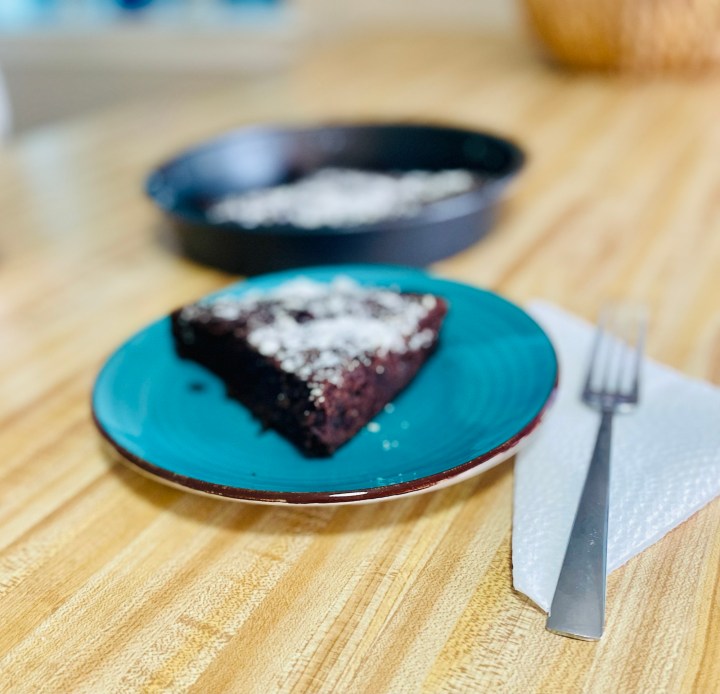
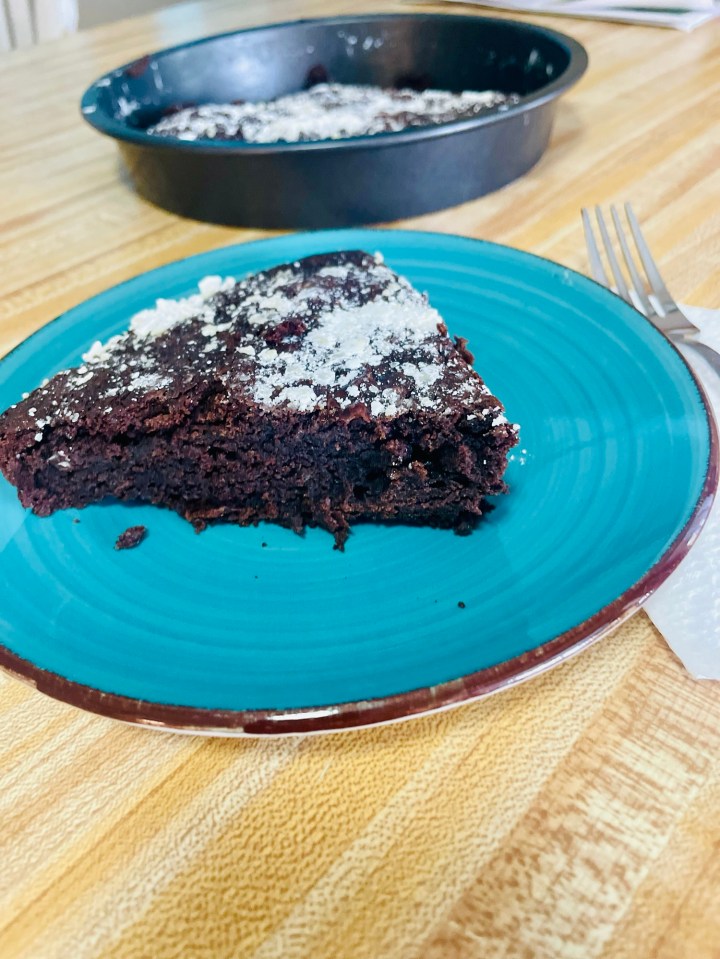
With basic knowledge, some trial and error, experimenting, and a good cooking converter, I think everyone can attempt to bake. The results may not always look picture-perfect (such as my humongous Galette des rois or snowed-out Almond Cake ), but the taste is there! My recent exploit is the basic French chocolate cake with a minimum amount of flour, or Gâteau au chocolat, and it was delicious, as per the family verdict!
I looked up recipes online, but wasn’t convinced by the ingredient lists, and I also didn’t want to venture into beating egg whites this time. ( I will try it when I make Mousse au Chocolat). For example, one recipe called for 5 whole eggs, very little chocolate, and an obscene amount of butter. I skipped the 1/2 packet of “Alsa levure chimique” or baking powder, and this is what I ended up using:
Ingredients:
- 280g dark chocolate ( I used Choceur 49% dark chocolate bars, about 10 oz/280 g)
- 4 whole eggs
- 1 cup/200 g sugar
- ½ cup/8 tbsp/113 g 1 stick unsalted butter
- About 5 tbsp/ 45 g white flour
- Dash of sea salt
- Powdered sugar for decoration
Direction Steps:
- Preheat Oven to 350 F /180 C
- Butter and flour, or “chemiser” the baking pan with a tablespoon of the butter and sprinkle a little flour
- Use a saucepan filled with water with a metal bowl on top, or a double boiler, and melt the cut-up chocolate in the bain-marie.
- Add the cut-up butter and fold gently until melted
- Remove from the heat and allow to cool a little so the eggs don’t get cooked
- Beat the eggs into the sugar, and beat into a “ruban”
- Add egg and sugar mixture to the chocolate with a few tbsp of flour
- Bake for about 25 minutes at 350F; the center must still be a little gooey or the cake will be too dry.
In the end, the cake came out of the pan easily and was very moist and chocolaty. It was served with a small scoop of extra-light vanilla ice cream and a drizzle of caramel, but it would be phenomenal with just a dollop of “Crème Chantilly, ” the real French whipped cream.
What would I modify and do differently? I would perhaps only use about 8oz/ 200g of 49-70% dark chocolate and definitely reduce the sugar to 3/4 cup/150 g. Made a big error, but it didn’t affect the outcome. Always beat the eggs and sugar separately and incorporate the mixture into the chocolate. Also, for the next cake, I’ll use 70% dark chocolate vs. 49% and I will only bake for 20 minutes, as my oven was very hot from a previous cooking session.
Let me know how your cake turned out! Miam! Miam!
When you click my links to shop on Amazon, I may earn a small fee that helps keep French A L.A Carte running. Thank you for supporting my work and the French ‘Art de Vivre’ community!”
Here are some suggestions for French baking essentials to add to your pantry for your next creations!
Discover more from French A L.A Carte Blog USA
Subscribe to get the latest posts sent to your email.

